With this article, I am launching the series “Avoidable Mistakes in Handling Electric Vehicles.” A new episode will be published every week, highlighting typical risks, real‑world examples from workshop practice, and concrete recommendations for safe operation. The goal is to strengthen awareness of high‑voltage (HV) safety and to prevent accidents before they occur.
To begin, we will look at the three most common mistakes I encounter in almost every workshop. Three factors that are already critical on their own — and together can create a dangerous chain reaction.
The Three Pillars of Disaster
1. Lack of Qualification
Working on high‑voltage systems without valid authorization according to DGUV 209‑093 is one of the most frequent and most dangerous errors. The rule is clear: No certificate, no HV work — without exception.
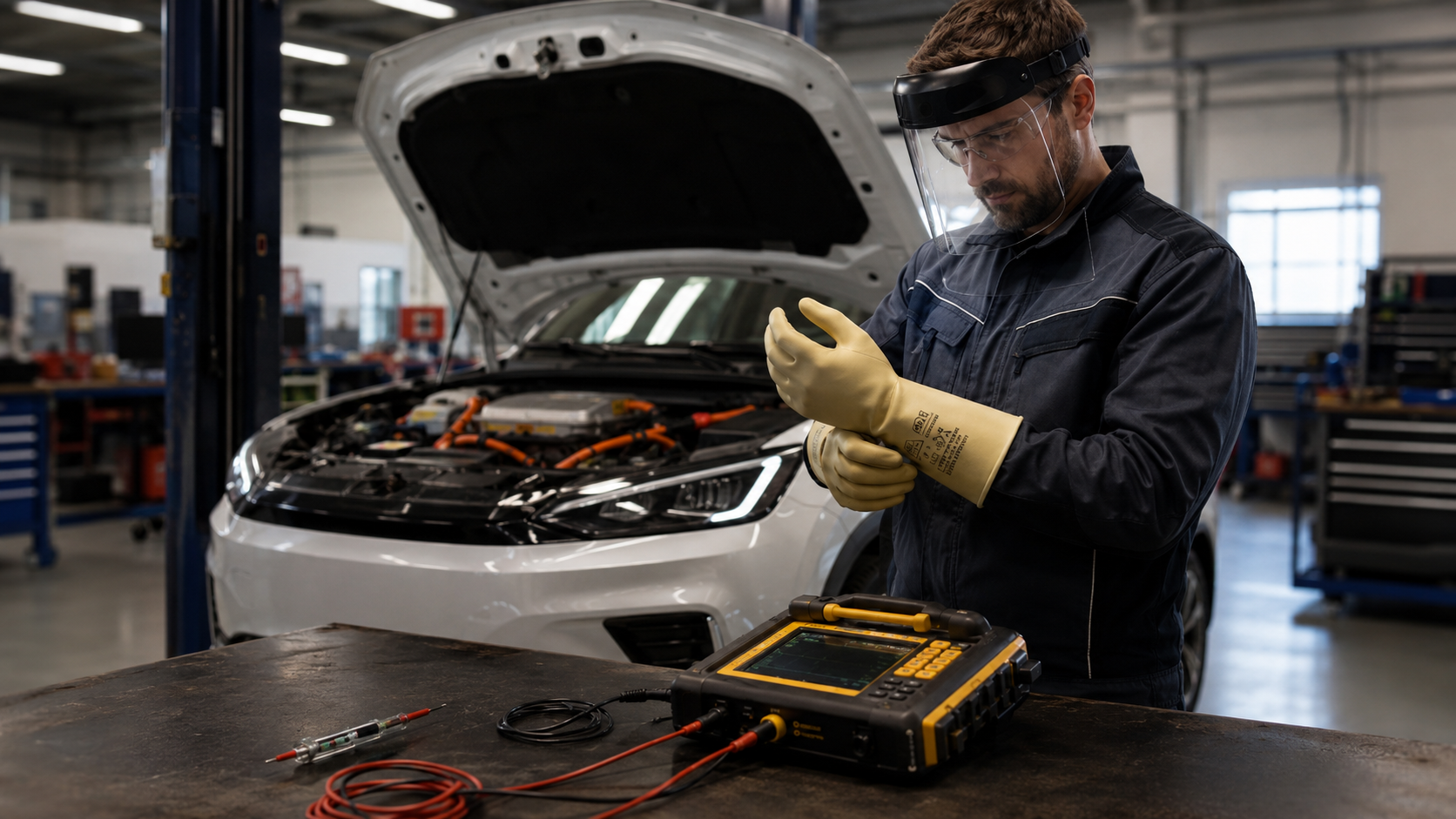
Yet it still happens that individuals work on HV components without ever having completed a Level‑2S or Level‑3 qualification. Common reasons include staff shortages, time pressure, or the misconception that one can “quickly check something.” But high‑voltage systems do not tolerate improvisation. Anyone working without proper authorization endangers not only themselves but everyone around them — and violates binding regulations.
Proper training provides more than theoretical knowledge. It teaches correct behavior, safe procedures, and an understanding of risks that are simply invisible without formal education. A lack of qualification is therefore not just an organizational issue — it is a critical safety hazard.
2. Incorrect Tools
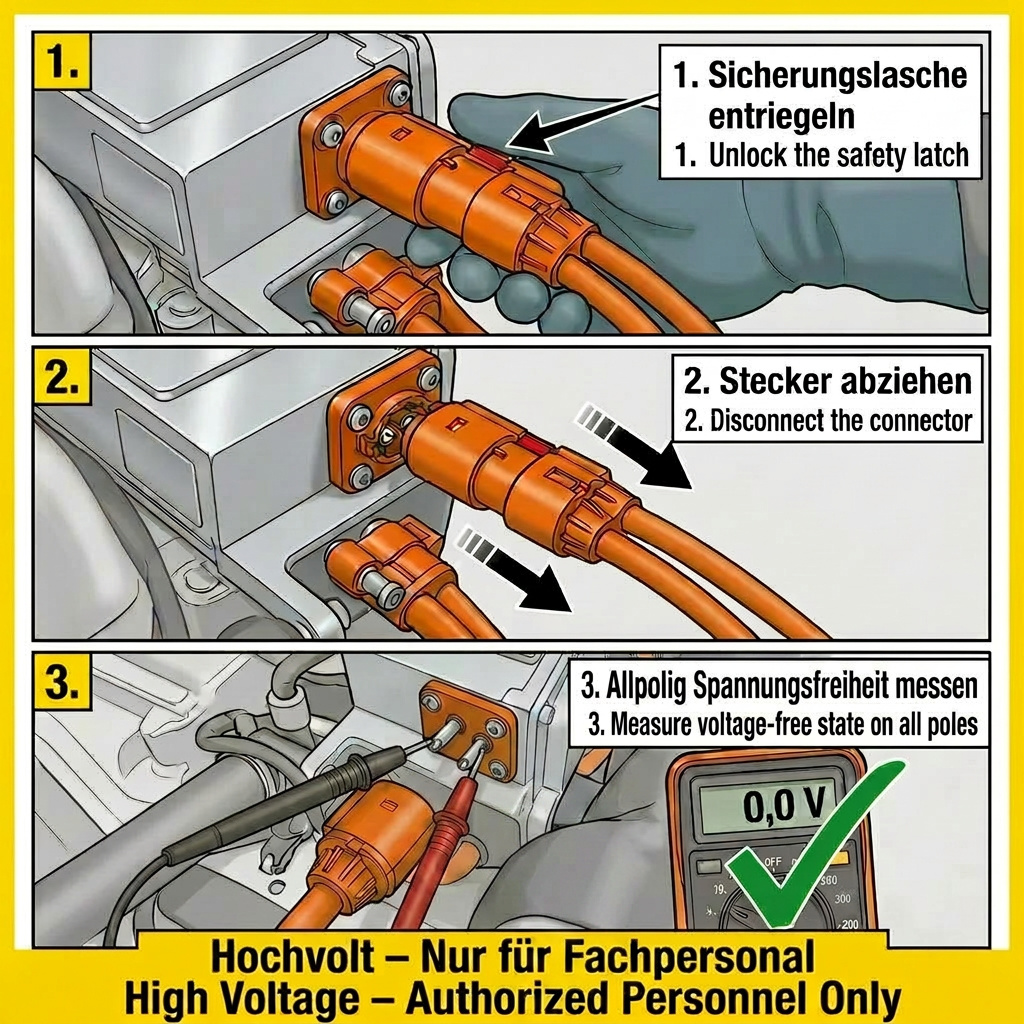
A simple single‑pole voltage tester is absolutely unsuitable for HV measurements. It cannot reliably determine the voltage state of a high‑voltage system and creates a dangerous illusion of safety.
For HV work, only two‑pole voltage testers of category CAT III or CAT IV are permitted. These devices must be certified according to DIN VDE 0682‑401 and must be checked before every use.
This is why tool selection is a core part of our training programs: we teach not only which tools are approved, but also why — and what risks arise when the wrong equipment is used. A measurement error in the HV domain is not a minor mistake; it is potentially life‑threatening.
3. Time Pressure
The required discharge time for HV capacitors is often ignored or shortened in practice. Depending on the vehicle, this period can last several minutes — and it is non‑negotiable. It is part of the manufacturer’s safety concept and prevents residual voltages from causing severe or fatal electric shocks.
Time pressure is the invisible enemy in every workshop. It must never lead to skipping safety‑critical steps. Especially in the HV environment, the rule is simple: Safety takes time — and shortcuts put lives at risk.
What’s Next in the Series
This was the introduction. In the coming weeks, a new episode will be published every Week, covering typical mistakes, real‑world scenarios, and actionable recommendations. Upcoming topics include:
- The most common misconceptions about achieving a zero‑voltage state
- Typical errors in PPE usage and lockout/tagout procedures
- What workshops must clarify before performing their first HV task
Safety begins with knowledge — and with the awareness that every mistake is preventable.