Who is allowed to determine the absence of voltage?
Determining the absence of voltage is one of the most important safety measures when working on electrical systems and high-voltage vehicles. It may only be carried out by qualified persons who have the necessary electrical expertise, instruction, and practical experience. Even if a system has already been switched off, that does not automatically mean that no electrical danger remains. In vehicles with high-voltage technology in particular, components such as capacitors or intermediate circuits can still store dangerous residual energy for a period of time.
For a safe start of work, it is therefore not enough to simply isolate or shut down a vehicle or system. What matters is that the absence of voltage is professionally verified and clearly documented. Only this step creates the necessary safety for all further work. That is why verifying the absence of voltage is not just a formal requirement, but a central part of a responsible and compliant work process.
Why this test is so important
Verifying the absence of voltage is the third step of the so-called 5 Safety Rules. This step is especially important because it establishes the basis for working safely on an electrical system or a high-voltage system. As long as it has not been clearly proven that no voltage is present, a residual risk always remains. The purpose of the test is precisely to eliminate that risk.
This is particularly crucial in the field of high-voltage vehicles. The systems of modern electric and hybrid vehicles operate with high voltages that can be life-threatening in the event of an error. Even after shutdown, voltages may still be present that are not visible at first glance. For this reason, discharge times, manufacturer specifications, and the correct measuring method must always be observed. Anyone who works imprecisely here not only puts themselves at risk, but also colleagues and the entire work process.
What “all-pole” means
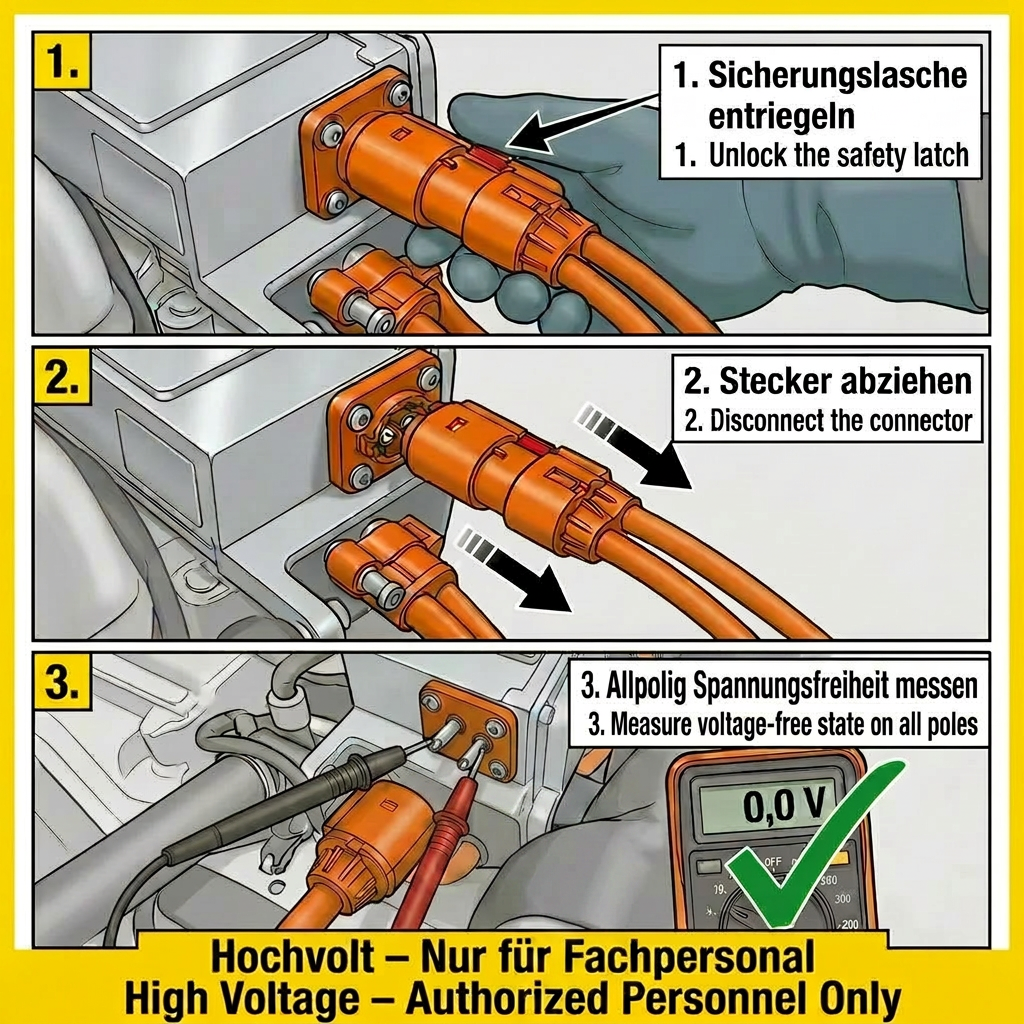
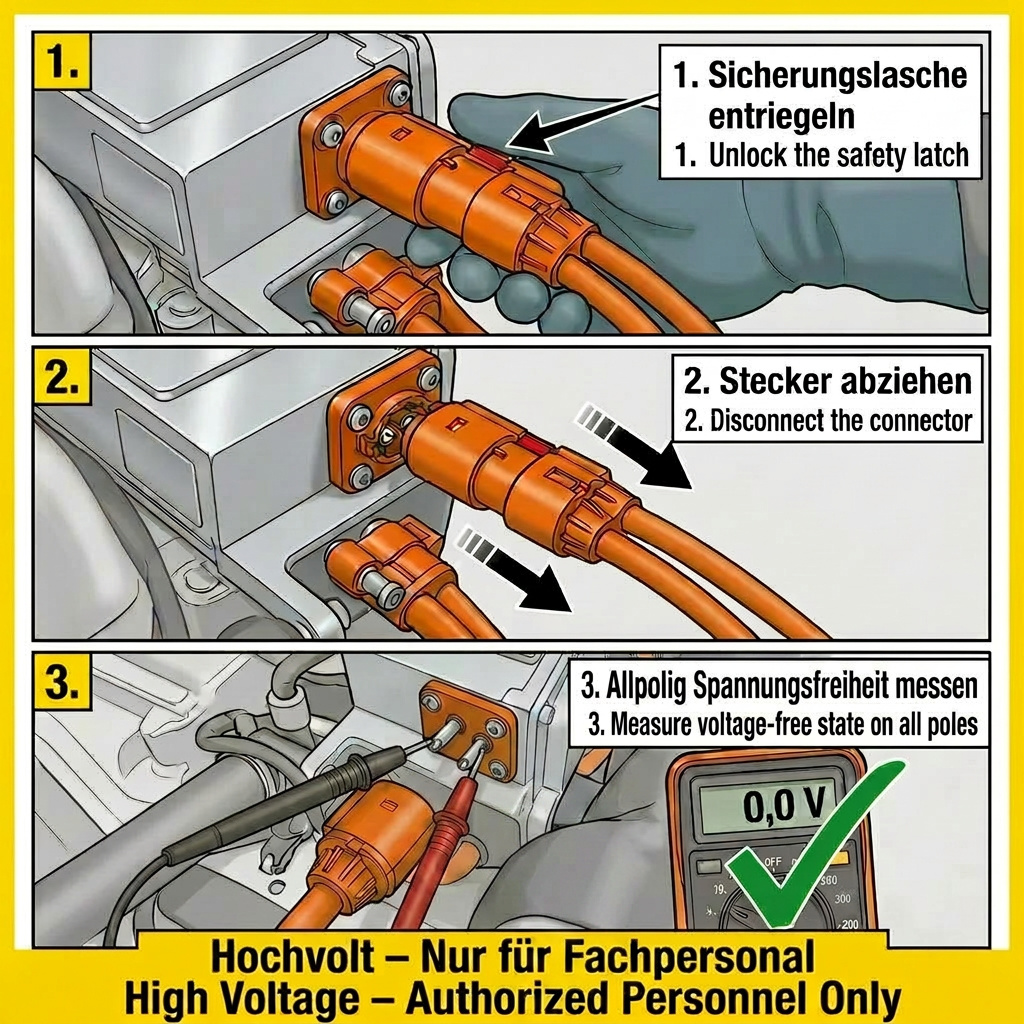
The term “all-pole” is often mentioned, but not always explained adequately. Yet this point is crucial for a safe and complete test. All-pole means that voltage is not measured at just one point, but across all relevant conductors and connections in the affected system. The goal is to detect every possible dangerous voltage difference.
In practice, this means it is not sufficient to measure only between two conductors and conclude that the entire system is safe. Such a partial measurement can be misleading, because another conductor may still be carrying voltage. That is exactly why the all-pole test is so important. It ensures that no dangerous residual condition is overlooked and that the statement about absence of voltage is truly reliable.
You can think of it like a complete check of a multi-core system: only when all relevant connections have been tested is it certain that no unintended energy flow remains. The all-pole test is therefore not unnecessary effort, but a necessary protective measure.
All-pole testing in practice
In conventional vehicles with 12-volt or 24-volt systems, the test usually means systematically checking positive, ground, and other supply lines. Even in these systems, it should not be assumed too quickly that no voltage remains after shutdown. Control lines, consumer connections, or adjacent electrical paths can still carry potentials under certain conditions.
In a high-voltage vehicle, the test is even more demanding. Here, the high-voltage lines must be tested not only against vehicle ground, but also against each other. This includes, for example, high-voltage positive and high-voltage negative, as well as all other relevant lines in the affected area. In addition, it must be remembered that certain vehicle components may still contain residual voltage after shutdown. In particular, capacitors in the inverter or other power electronics components can store dangerous energy.
That is why it is so important to observe the waiting times specified by the manufacturer before starting the measurement. Anyone who measures too early risks false results or even exposure to remaining residual voltage. The all-pole test must therefore always be considered together with the overall system condition and the manufacturer’s technical requirements.
The correct testing procedure
To verify the absence of voltage reliably, it is not only the measurement itself that matters, but also the test device and how it is used. A suitable, functional measuring instrument that is approved for the relevant voltage range is essential. Before the measurement begins, the device should be checked for visible damage, proper function, and suitability for use.
In practice, the BEFORE–DURING–AFTER principle has proven effective. First, the voltage tester is checked on a known live source, then the actual measurement is carried out, and finally the device is tested again. This procedure is especially important because a measuring device can be damaged during use, for example by a blown fuse or a defective test lead. Without the final check, a faulty device could create a false sense of safety.
Conclusion
Verifying the absence of voltage is an essential safety component when working on electrical systems and high-voltage vehicles. It may only be carried out by qualified persons and requires a systematic, careful, and standards-based approach. The all-pole test is especially important, because only it ensures that no dangerous voltage is overlooked on a single conductor, between conductor combinations, or in the entire system.
This is precisely where high-voltage technology shows how important expertise, care, and clear procedures are. Residual voltage, stored energy, and manufacturer-specific requirements make an exact test indispensable. Anyone who verifies absence of voltage completely, all-pole, and with a suitable testing procedure creates the basis for safe work and significantly reduces the risk of accidents. For training in the field of high-voltage vehicles, this knowledge is a central element because it combines safety, practical relevance, and responsibility.