Why Rule 1 Is More Critical in the Automotive Industry Than in Theory
Rule 1 of electrical safety is crystal clear: Before working on any conductive high‑voltage (HV) components, the HV system must be completely de‑energized. No compromises, no shortcuts, no interpretation.
In classical electrical engineering, this rule is usually straightforward to implement because systems are standardized, predictable, and follow well‑defined shutdown procedures. In the automotive world, however, the situation is fundamentally different. Modern electric and hybrid vehicles are complex, highly integrated systems with manufacturer‑specific architectures, shutdown sequences, and safety mechanisms.
Anyone who relies on routine, gut feeling, or experience from other vehicle models risks exposing themselves and others to invisible — and potentially fatal — hazards.
De‑energizing an HV System Is Not the Same Everywhere
No Universal Standard
In theory, the process is simple: switch off, secure, verify. In practice, every vehicle model follows its own shutdown logic. Some vehicles require only a single action, while others demand a multi‑step sequence involving mechanical disconnects, electrical isolation, software‑based shutdowns, and defined waiting periods.
There is no universal method, and this is precisely why Rule 1 is significantly more demanding in the automotive sector than in traditional electrical engineering.
Safety Chains Like HVIL Add Complexity
Modern vehicles use interlock and HVIL (High Voltage Interlock Loop) systems that only respond correctly when the exact prescribed sequence is followed. A single incorrect step can cause the HV system to appear inactive while still carrying dangerous voltage levels.
To the technician, the vehicle may seem safe — but in reality, high voltage may still be present in critical components.
“Ignition Off” Does Not Automatically Mean Safe
Some manufacturers allow a simple “ignition off” procedure — but only if the internal shutdown logic completes successfully. Others require significantly more:
- Removing the battery disconnect plug
- Disconnecting the 12‑V battery
- Observing defined waiting periods
- Following software‑guided shutdown sequences
In the workshop, only the manufacturer’s instructions determine the correct shutdown procedure. Personal judgment or assumptions have no place in HV safety.
The Three Most Common Practical Problems
1. Same Term — Different Components
The instruction “remove the service disconnect” sounds clear, but often it is not. In many vehicles, this does not refer to the HV battery’s Manual Service Disconnect (MSD). Instead, it may refer to a connector that only triggers an interlock‑based shutdown.
What Is the MSD?
The Manual Service Disconnect is a mechanical device designed to:
- Physically isolate the HV system
- Open the HVIL circuit
- Prevent arcing during disconnection
However, not every orange connector is an MSD — and confusing them can be dangerous.
Wrong Connector = Unsafe Condition
If the wrong connector is removed, the HV system may remain energized. This danger is invisible and cannot be detected without proper measurement.
The Only Reliable Solution
Only the official manufacturer documentation (WIS, ELSA, OEM repair systems) clearly identifies which connector performs which function. Experience from other models is not transferable.
2. Interlock/HVIL — The Invisible Switch
The HVIL monitors all HV connectors through a pilot line. As long as the circuit is closed, the HV system is allowed to remain active.
A wrongly removed connector may:
- Trigger the interlock
- But not deactivate the HV system correctly
The vehicle reacts — but not in the way the technician expects. This is why the prescribed sequence is not bureaucratic red tape; it is an essential part of the safety chain.
3. Residual Energy and Time Delays Are Often Underestimated
Capacitors in the Inverter
Even after removing the service disconnect, capacitors in the inverter can still hold hundreds of volts. This stored energy is invisible and extremely dangerous.
A Time‑Dependent Process
Manufacturers specify waiting periods — typically 5 to 10 minutes — to allow capacitors to discharge. Only after this period may the technician verify the absence of voltage.
Rule 1 is therefore not a simple “plug in/out” action but a time‑dependent safety process.
Additional Shutdown Methods and Their Specific Challenges
Mechanical Separation of the HV Battery
Removing the battery disconnect plug splits the battery internally, interrupting the circuit. But implementation varies:
- Classic MSD
- Battery master switch
- Manufacturer‑specific separation points
Disconnecting the 12‑V Battery
Some manufacturers require this step to prevent control units from reactivating the HV system. This step is often overlooked.
Software‑Based Shutdown
Modern vehicles increasingly rely on software‑controlled shutdown processes via diagnostic tools or onboard menus.
But one rule remains absolute: Software shutdown never replaces voltage measurement. It is only the first step.
The Critical Bottom Line
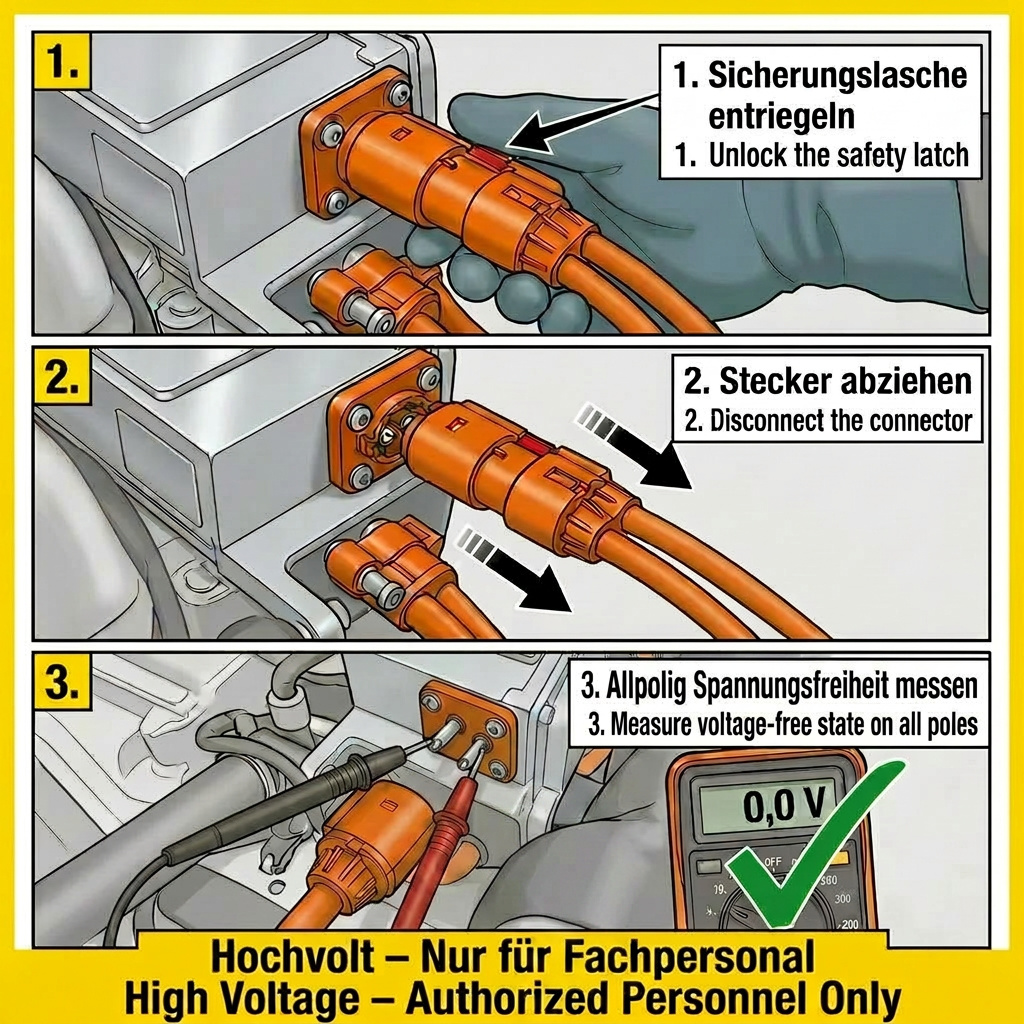
Rule 1 is only complete when the absence of voltage has been verified through measurement — regardless of the shutdown method used.
In automotive applications, de‑energizing an HV system is not a theoretical standard process but a vehicle‑specific, safety‑critical procedure that only works when the manufacturer’s instructions are followed precisely.