HV components training is the technical core of qualifying as a Qualified HV Person (FHV) under DGUV Information 209-093. Anyone who wants to work independently on electric or hybrid vehicles must do more than master the Five Safety Rules – they must understand how HV components are constructed, how they function, and what specific hazards they present.
What Are HV Components Under DGUV 209-093?
The norm defines the term precisely in Section 2, No. 2:
"HV component: provides a voltage in accordance with the definition of 'high voltage' in vehicles, or is operated at that voltage."
High voltage covers potentials above 60 V DC or 30 V AC – well above the threshold at which electrical current becomes dangerous to the human body (UNECE R100). Typical HV components in modern electric and hybrid vehicles include:
- Traction battery: Lithium-ion energy storage, typically 300–800 V DC
- Inverter: Converts DC to three-phase AC for the electric motor
- DC/DC converter: Links the HV network to the 12 V on-board electrical system
- On-board charger (OBC): Charges the traction battery from AC mains
- Electric motor: Three-phase asynchronous or synchronous machine
- HV cables and wiring: Identified by orange insulation connection between HV-components
- Service disconnect plug: Safety isolation device for maintenance work
Why Is Basic Sensitisation Not Enough?
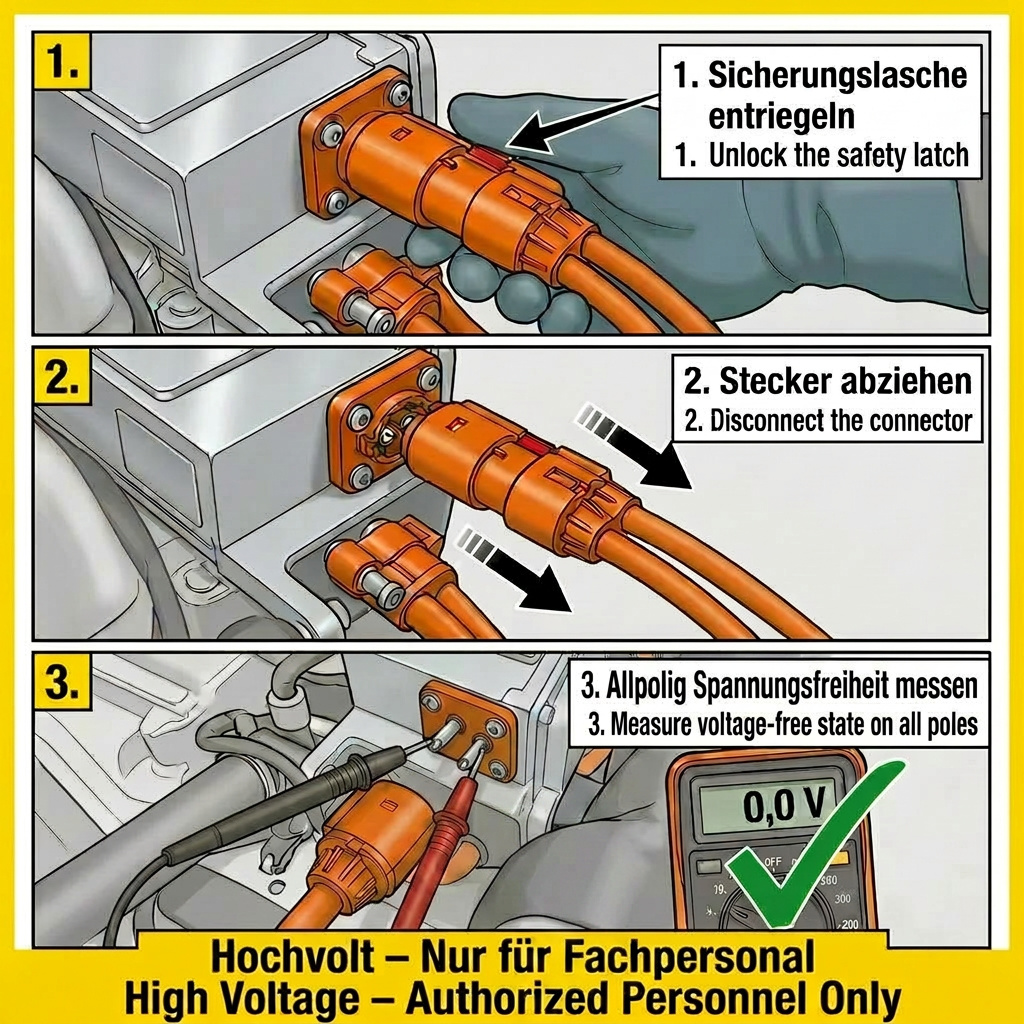
Under normal operating conditions, installed HV components in series-production vehicles pose no direct electrical hazard – as DGUV 209-093 Section 5.1.1 notes. But during repair and service work the situation changes fundamentally: the technician enters the hazard zone, must de-energise the HV system, verify voltage-free status, and then work deliberately with HV components.
The norm is unambiguous: "Work on HV systems in the de-energised state may only be carried out by Qualified HV Persons (FHV) or under the direction and supervision of an FHV." (Section 5.1.4)
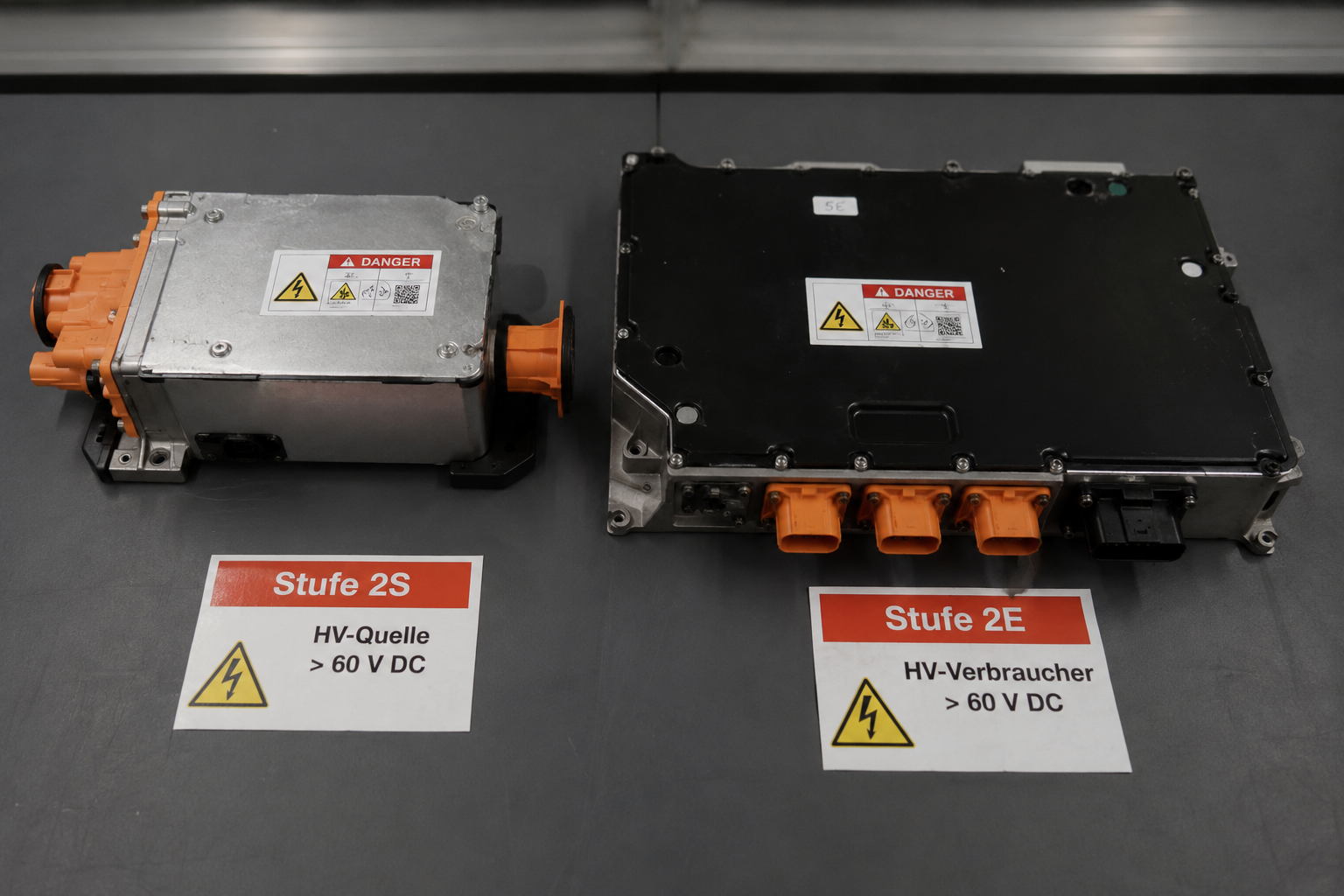
Level 2S vs. Level 2E: What Is the Difference?
Level 2S applies to work on series vehicles – the relevant qualification for workshops, dealership service departments and fleet maintenance operations. It authorises independent work on de-energised HV systems in production vehicles.
Level 2E covers research, development and production contexts – work on prototypes, pre-series vehicles and manufacturing processes prior to the official Start of Production (SoP). Both levels are prerequisites for the highest qualification (Level 3S or 3E).
What Does HV Components Training Cover?
The qualification content for Level 2S is laid out in detail in Annex 6 of DGUV 209-093. Level 2E content follows Annex 4. The following subject areas are mandatory:
Electrical Engineering Fundamentals
DC and AC voltage, Ohm's Law, series and parallel circuits, electrical power. Energy storage: lithium-ion batteries, NiMH accumulators, supercapacitors, fuel cells. Measuring instruments: digital multimeters, two-pole voltage testers per DIN EN 61243-3, insulation resistance meters.
HV System Concept and Vehicle Technology
Architecture and function of HV components within the overall system. Hybrid drives, battery electric vehicles, fuel cell vehicles. Safety interlocks (interlock/pilot line), protective potential equalisation, insulation monitoring.
Electrical Hazards and First Aid
Effects of electrical current on the human body (perception threshold, let-go threshold, ventricular fibrillation, burns). First aid for electrical injuries, behaviour in fire situations, accident reporting.
The Five Safety Rules
De-energise – Secure against re-energisation – Verify voltage-free status – Earth and short-circuit (restricted for HV vehicles) – Cover adjacent live parts. Importantly, HV energy storage devices must not be short-circuited – manufacturer-specific instructions are always mandatory.
Personal Protective Equipment (PPE)
For example: Insulating gloves per EN 60903 (Class 0: up to 1,000 V AC / 1,500 V DC), VDE-tested insulated tools per EN 60900, CAT III measuring instruments per IEC 61010.
Practical Exercises (Mandatory)
The norm explicitly requires that all participants carry out hands-on practical exercises, including:
- Carrying out the de-energisation process on a real vehicle
- Removing, securing and re-inserting the service disconnect plug
- Verifying voltage-free status with a two-pole voltage tester
- Performing insulation and potential equalisation measurements
- Replacing HV components in the de-energised state
Training Duration (1 UE = 45 minutes)
DGUV 209-093 specifies minimum durations that differ depending on whether the qualifications are S or E. An example based on the S qualifications:
- Entry A (technical training, no electrical background): minimum 80 UE, at least 8 UE practical
- Entry B (automotive mechatronics, auto electrician, mechanic): minimum 16 UE, at least 8 UE practical
- Entry C (electrotechnical training): individual, minimum 8 UE practical
Note: Automotive mechatronics technicians trained under the 2013 German vocational regulation already hold Level 2S competence – but still require regular refresher training to keep their knowledge current.
Certificate and Documentation
Training is completed with a theoretical and practical examination. The certificate (template in Annex 8 of DGUV 209-093) must include the training provider's name, course content with hours per topic, list of vehicle systems covered in practical exercises, and the course director's signature.
After qualification, technical knowledge must be kept current through regular refresher training. Annual instruction is a legal requirement for all qualification levels. Full details on our Level 2S training and Level 2E training are available on our website.